Search This Blog

Showing posts with label Indoor. Show all posts

Tuesday, April 21, 2015

Coping Skills Freeze Tag


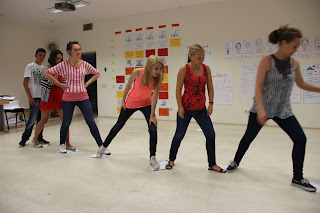
Coping skills freeze tag is great for people to identify coping skills that they can use and when they can use them. Peers listening to each other's coping skills can also help give new ideas.


How To Play:
Designate one player as 'it' with the other players scattered throughout the playing area. The person who is it tags the other players. When a player is tagged, (s)he freezes. To be unfrozen, the player has to name a coping skill and be unfrozen by getting a high-5 from another peer who is not frozen.
I like to make a rule that people cannot repeat coping skills so that they have to think of more.
With younger groups, you may need to talk about what coping skills are beforehand and have older kids give examples so everyone understands.

Discussion:
Coping Skills: ask each participant what their favorite coping skill is and when they can use it

Please Share Your Thoughts and Ideas:
What are things you would discuss with this game?
What are some other ways that you like to play tag?

Other Variations on Playing Tag:
Triangle Tag
Animal Tag
Freeze-Tag Toss
Spot Tag  

Image Credit: http://www.forthoodsentinel.com/images/photos/15751_tn.jpg

Saturday, April 4, 2015

Origami Easter Eggs

At our facility this year, we are not allowed to use plastic eggs for the Easter egg hunt so we got a  creative and made origami Easter eggs with the patients for group! We will hide these Easter morning and have an Easter egg hunt!!!


Materials
  • 5 pieces of origami paper for each patient
Instructions
Have the patients pick a partner and sit at a table next to each other. Tell everyone to raise the hand they write with and then put it behind their backs. Give them the instruction page on this blog. During this activity, they can only use their non-dominant hand and work with their partner. Each partnership will make 10 origami eggs.

*Watch the patients closely, if they are anything like the patients at my facility they will try to switch hands or use both.


Discussion
*This activity spurred a long discussion. Many of the patients tried to cheat, some became frustrated and yelled at their partner, and one partnership worked really well together.
Importance of Instructions/Rules: we talked about the importance of rules on the unit and why we have them on the unit and in life
Communication: how to communicate effectively (tone, accusatory language, etc.)
Teamwork: ways to work with others
Listening
Frustration Tolerance/Management
Importance of Practice: talk about how things get easier with time and have patients give an example of something in the past that became easier with time or a goal they are currently working towards and how they are going to be patient with themselves

Please Share
How would you wrap this activity up with a group?
What other Easter crafts do you do with your patients?

More Easter Activities
Easter Banners
Easter Puppet Bunnies
Easter Bags

Image Credit
https://blogger.googleusercontent.com/img/b/R29vZ2xl/AVvXsEjqfYLqdN43DwaPtQAvfQyrrgfrAdQuM1zwk4HmueUwWnvFvvAKvFVn73-UOp8nFm5M35rm_QxdeYmhQwlYloFxzVBcgRmoiVPX2AOCtrgfZj7qhAxXp1xYJsVCQWu72doD9pmjjaNg8_SY/s1600/egg.gif


Easter Banners

Materials
  • Butcher Paper
  • Paint 
  • Paint Brushes
  • Cups of water and napkins (to clean paint brushes)
Instructions
Tell the patients that they are going to make an Easter Banner to decorate their unit. Give them the supplies and have them talk about how they are going to decorate it. Let the patients drive this activity and just watch for anything inappropriate. All of my groups loved this!

Discussion
Teamwork: what did they do to work together? Did a leader come out among them?
Communication: where there any problems with communication? How did they clear these up?
Expressing self with others: how can we express ourselves but still be part of a team?

Please Share
What are other ways that you would do this activity?
How would you discuss this activity?
What other Easter activities have you done with patients?

More Easter Activities
Origami Easter Eggs
Easter Puppet Bunnies
Easter Bags

Easter Puppet Bunnies


Materials
  • Brown bag for each patient
  • 3 sheets of construction paper for each patient
  • Glue
  • Scissors
Instructions
Give each patient a brown bag and three pieces of construction paper (I let them choose their colors). Two of the pieces of paper will be used to cut out the eyes, ears, feet, nose, teeth, and whiskers for the bunny. These will be glued on the front side of the bag (where the flap folds over-put the face on the flap). One piece of paper will be balled and glued on the back side of the bag to be the tail.

If you have more paper, they can make a carrot and put it in the bunny's mouth.

Discussion
Problem solving: give the patients the materials and tell them what the end product needs to be but do not give the middle instructions.
Importance of Rules: give the patients step-by-step instructions and talk about the importance of rules.

Please Share
How would you discuss this activity?
What do you do to celebrate Easter?

More Easter Activities
Origami Easter Eggs
Easter Banners
Easter Bags

Easter Bags

This is such a fun and beautiful holiday! I love celebrating the Resurrection of our Lord and Savior, Jesus Christ.

At my work, we do not celebrate religious holidays though so we focused more on secular celebrating of Easter. We made Easter bags!

Equipment
  • One brown bag for each person
  • Paint and paint brushes - this can also be done with markers/crayons/colored pencils
  • Napkins and cups of water (to clean the paint brushes with)
  • One paper plate for each person
Instructions
Each patient received a paint brush, plate, and brown bag. To start with, I filled each person's plate with three colors of their choosing. Patients could request more paint after everyone had received paint. Then the patients began painting. The only direction I gave them for painting was that these were their Easter bags. One patient made a beautiful picture of the cross on the hill, another painted "Happy Easter", more psychotic patients just did scribbles of paint, etc. The children, adolescents, and adults all enjoyed this activity.


Discussion
Family rituals: we talked about the different rituals each patient had with this holiday and how family rituals are so important to keep members of the family close.
Self-expression: expressing ourselves on our regular basis and the benefits thereof.
Relaxation: the importance of participating in relaxing activities and activities that relax us.

Stuffing the bags
After the group, I collected the bags and stuffed them with candy and different activity pages. The patients will receive their bags Easter morning!

Activity Pages Links (these pages all print well)
Coloring Pages
  •  http://www.coloring.ws/t.asp?t=http://www.coloring.ws/easter/easter3.gif
  • http://www.crayola.com/services/printService.aspx?i=5a02a505-b083-4b0b-8a7b-27a128ef626e
  • http://www.crayola.com/free-coloring-pages/print/easter-egg-wreath-coloring-page/
  • http://www.crayola.com/free-coloring-pages/print/easter-eggs-coloring-page/
  • http://www.crayola.com/free-coloring-pages/print/easter-lilies-coloring-page/
Color By Number
  • http://www.activityvillage.co.uk/bunny-maths-facts-colouring-page
  • http://www.activityvillage.co.uk/chicken-maths-facts-colouring-page
Drawing
  • http://www.activityvillage.co.uk/chick-symmetry-worksheet
  •  http://www.activityvillage.co.uk/easter-egg-symmetry-worksheet
  • http://www.activityvillage.co.uk/rabbit-symmetry-worksheet
Color By Coordinate
  • http://www.activityvillage.co.uk/easter-bunny-coordinates
  • http://www.activityvillage.co.uk/easter-chick-coordinates
  • http://www.activityvillage.co.uk/easter-egg-coordinates
Mazes
  • http://www.activityvillage.co.uk/easter-bunny-maze
  • http://www.activityvillage.co.uk/easter-egg-maze
  • http://www.activityvillage.co.uk/easter-maze-1
  • http://www.activityvillage.co.uk/easter-maze-2
  • http://www.activityvillage.co.uk/easter-maze-3
  • http://www.activityvillage.co.uk/easter-path-puzzle
  • http://www.activityvillage.co.uk/rabbit-maze-2
Word Sudoku
  • http://www.activityvillage.co.uk/easter-word-sudoku-easy-1
  • http://www.activityvillage.co.uk/easter-word-sudoku-easy-2
  • http://www.activityvillage.co.uk/easter-word-sudoku-medium-1
  • http://www.activityvillage.co.uk/easter-word-sudoku-medium-2 
Word Scramble
  • http://www.crayola.com/free-coloring-pages/print/easter-scramble-coloring-page/
Please Share
What activities have you done to celebrate Easter?
What activity pages have you used?

More Easter Activities
Origami Easter Eggs
Easter Banners
Easter Puppet Bunnies

Image Credit
https://encrypted-tbn1.gstatic.com/images?q=tbn:ANd9GcRkFSmCDioyKOJy2PpClTIf1uUNk7TZ6_uS3av0OdhsRKbtHLNg

Tuesday, March 24, 2015

Group Juggling


Equipment: one ball for each person in the group


Objectives
First, ask your group who can demonstrate juggling (There is usually at least one person who can juggle). Ask, “Who can juggle the most balls?” Two or three balls are usually the limit.
Now have everyone (usually best with 8-12 people) stand in a circle about arm’s length apart.
Ask the participants to throw the ball to someone in the circle that is not standing next to them. each person catches the ball only once except it must start and end with the same person. tell them you are creating a pattern; they need to remember to whom they threw the ball and who threw it to them.
After the ball has made it around the group once, send in more balls until there are two less than the number of people in the group, or until they start dropping a lot. Try it two or three times. Ask them to be more efficient each time.

Discussion
How much more can a group accomplish than an individual?
What happens to the process when one person drops a ball? How does the group compensate?
Whose responsibility is it?
What does it take for a team to be successful?

Variations
Use stuffed animals instead of ball and use the story of Noah’s Arc and tell them water is coming in and we must juggle the animals to keep them from falling in the water.

 Image Credit:

Monday, March 2, 2015

Group Sit


Equipment: a rope tied in a circle

How to Play:
Put the rope on the ground. Have the participants grab the rope and pick it up to waist level. (You can have the rope tangled and tell them to untangle it at this point if you want to make it more challenging). Tell the participants to walk back until the rope is tight and to spread out evenly on the rope. Now, they are to sit down together as a team without ever moving their feet.

Discussion:
Discuss the importance of every member of the team
Teamwork
Communication
Feeling of Accomplishment
Enduring (not giving up even when it seems impossible)
Problem Solving
If someone stepped up to be a leader during the task, talk about leadership skills
If the group became frustrated, talk about healthy ways to deal with frustrations

Please Share:
What variations have you seen done with this activity?
How would you discuss this with your group?

Image Credit: http://hative.com/wp-content/uploads/2014/05/team-building/12-team-building.jpg

Tuesday, February 24, 2015

Spot Tag


Spot tag is a funny game for the participants to break the ice, laugh with each other, and work on important skills. They quickly realize how hard running is while trying to hold their leg, ankle, arm, head, etc.

How To Play:
Designate one player as 'it' with the other players scattered throughout the playing area. The person who is it has a ball (that is soft) that he throws to tag the other players. When a player is tagged by the ball, he has to cover the spot where he was tagged with one hand (but is still allowed to be chased) and continues running around. When tagged a second time, the player uses his other hand to cover the spot where he was tagged (but he is still allowed to be chased). When tagged a third time, he/she switches places with the person who is 'it'.

Once the ball hits the ground, it is considered "dead" so if it bounces and hits someone, that does not count. Also, only the person who is it can pick the ball up. No other player can pick it up.

Discussion:
Anger management: talk about how our anger can hinder us and how we can learn to control it
Depression: similar to anger, talk about how depression can hinder us and how we can improve our mood
Laughter: talk about the importance of laughter and enjoying ourselves
Exercise: talk about the importance of exercise and how it can improve our mood and is good for us

Please Share Your Thoughts and Ideas:
What are things you would discuss with this game?
What are some other ways that you like to play tag?

Other Variations on Playing Tag:
Triangle Tag
Animal Tag
Freeze-Tag Toss 
Coping Skills Freeze Tag 

Image Credit:
https://aames3.files.wordpress.com/2011/04/kids-running_300.jpg

Monday, February 16, 2015

Lava River


Objective: participants work together to move entire group across simulated “lava river”

Emphasis
·      Develop cohesion and teamwork
·      Enhance communication skills
·      Stimulate care and concern for others through individual and group responsibility
·      Identify or improve leadership potential
·      Establish support systems

Materials
·      A large open area, a hallway or gymnasium floor
·      One block, brick or rock for each participant (various sizes of cut 2”x4” work very well. Pick up scrap lumber, different shaped wood from a construction site or a piece of paper if you are really low on budget/time)

Instructions
·      Mark a start and finish line on the field
·      Give each participant one block. Explain the only place a team member can step is on the blocks
·      Team members lay down the blocks one at a time in a line toward the finish point, with team members standing on the blocks. It will be necessary to share blocks in order that an extra block is made available
·      Pass the extra block to the front team member who places it on the ground in front of him
·      Repeat this process until all have crossed the “lava river”

Variations
·      Have each member choose a block that represents them. then allow each member to share with the group the attributes that the block possesses that are similar to the individual. Do not give any instructions as to how to complete the task. Remind them the block represents themselves and others and they need to learn and practice using themselves and others as a support system
·      Teach social responsibility by establishing the rule that if one team member steps off the blocks or has some other miscue where the floor is touched, the entire team must return to the beginning to start the exercise again
·      Divide large groups into competing teams and challenge each other to the finish line, or race against set time
·      Give an extra block to the group, or take one block away
·      Blindfold a member of the group to increase care and responsibility for one another
·      Individuals must step on the blocks and not skate across the area on them
·      Do not give specific instructions, but tell group to figure out possibilities
The group must get everyone through an electric tunnel. No one can touch any of the interior or exterior sides of the tunnel or anything that is touching those sides. The group is provided with some “insulated blocks.” Location should be any open area where a tunnel can be improvised out of boxes, etc. or an area where a tunnel area

Image credit: https://blogger.googleusercontent.com/img/b/R29vZ2xl/AVvXsEi1O1D-3RK-FCODUOUGrWnSDhDGxzyAiY3WvVV8MLp8KthusIvKK93UaXPNmnHuMupkhxG43d4ucf6RkvPMKuLXzmCXsZd6I7MDH7f6Jid5TD3mEZVhiIY1PobBqmxLSFBn2AJCLnXE3yE/s1600/IMG_3220.JPG

Monday, October 20, 2014

Tarp Maze


Equipment
  • Tarp with a grid on it
    • Make the grid as big or small as your group will need it
  • Pen
  • Piece of paper
Objectives
Place the tarp on a flat surface with the grid side facing up. Select one member of the group to be the guide. Draw a grid on the piece of paper the same as the one on the tarp. The guide then chooses a course through the maze using 8-15 steps, and draws the course on the piece of paper using numbers.

 
The rest of the team lines up on one side of the maze and tries to guess their way through the course without the map. As the first person steps into a square, the guide will tell them whether or not that square matches the #1 on the map. If they are wrong, the guide makes a buzzing sound, and they must go to the end of the line and let someone else try. If they guess correctly, they can keep moving until they make a mistake. The team must try to remember the pattern on the map to eventually make it through the maze.

*The guide can be the CTRS/leader of the activity or you can assign a group member to do this.

Variation
Time them secretly on the first try. After successfully completing the course, tell them their time and then have them try it again (with a different way through the maze), timing them again. Discuss the differences.

Discussion
  • How many times did you make a mistake because you couldn’t see the map?
  • Do we live life by trial and error, or do we follow others advice/example?
  • Why was there such a difference between the two times? Discuss urgency.
  • Was this frustrating? How did you handle the frustration?
  • Did anyone step forward to be the leader? How did they lead? How would this have worked out if no one stepped up to be the leader?
  • Did everyone listen to each other? 
  • Could this have been solved if no one paid attention to their teammates going through? 

Saturday, September 27, 2014

Traffic Jam

Equipment
  • Something for each participant to stand on plus one extra - I've used foam squares, put X's on the floor with tape, etc.
    How To Play
     The participants stand in a semi-circle with one marker on the ground that each participant stands on. Put the extra marker in the middle (you do not need an equal number of participants). All participants should face in-wards toward the empty marker. The object of the game is to get the two sides to pass each other, ultimately switching sides by moving strategically from one marker to another.


    Rules
    • Only one person can be on a marker at a time
    • Participants can only move to an empty marker
    • Participants can only move forward - if the group gets struck, everyone has to start over
    • Participants can skip one person going the opposite direction, but s/he cannot skip someone going the same direction (to walk around the other person, the participant can step off the marker and walk around the person to step on the empty marker)
    Variations
    • When the group gets stuck and has to start over, have the participant at the front marker move to the last marker so there is a new person leading every time
    • Have the group do it without talking. Be strict about it, and when they start to get frustrated, allow them to talk. Process the differences after the activity
    • Once the group gets it the first time, have them do it while holding their breath. If someone breathes (exhales or inhales) in the middle, make them start over. This takes precise knowledge and planning. After, process the difference  between just doing what you are told and knowing your place/role.
    • Try the activity with two lines in a "plus sign" formation with one empty spot in the middle

    ·   
        Solution
    ·      This activity works even if you have odd numbers. First move a person forward into the empty space. Then the first person from team 2 goes around to the empty space, and the second person from team 2 steps forward. This pattern continues (team 1 moves one person, team 2 moves two people, team 1 moves three people, team 2 moves four people, etc.) until all people are moved. After all have moved, the pattern is reversed: five people move four, three, two, one.
    ·      Hint: There are three “unspoken rules” that if followed, will solve this puzzle. First, at every juncture, there are only two possible moves: one will get them stuck and the other will not. Second, participants from opposing team should always be alternating on the spaces. If one team has two in a row, they have created a traffic jam. Third, for the first half of the game, when they arrive at a juncture, always move the person that is positioned closer to the outward tails of the semi-circle, not the person closer to the center. After all participants have moved, the pattern is reversed.

    Lessons Learned
    Process with the group throughout - talk them thru their frustration, ask how their current solution is working, help them listen to each other if they are struggling to do so, etc.

    Problem Solving: At the beginning of the activity, participants often say this activity is impossible, but by the end, they feel great! When the group makes unanimous decisions, they usually make fewer mistakes. Some problems get solved much faster if you focus on the process or how you are interacting, rather than focusing on the problem.
    • How did it feel to accomplish an “impossible” task? 
    • Would you be given a task if there was not a way provided to accomplish it?
    • What steps were taken to get the activity done?
    ·      Communication:
    •       Whose ideas were important? (every suggestion)
    ·      Teamwork:
    •       How many people did it take to do this activity?
    •       How difficult would it be to accomplish this task if someone was not cooperating or doing their part?
    ·      Frustration

         Enduring
    •       What was more rewarding, the fact that everyone is standing in a different place or the process that brought you there? How does that relate to your life and other projects you are involved in?

    Picture Credit:
    First picture: http://www.playmeo.com/uploads/89ac3ca9270f995412eccd8c13c609bd.png
    Second picture: http://eaglepointresort.com.ph/wp-content/uploads/2014/08/team-building-project-adventure-w18368-traffic-jam-4.jpg

    Tuesday, September 23, 2014

    No-Outs Dodgeball

    The rules are the same as dodgeball, but there are no outs!


    Materials:
    • 10-15 dodgeballs
    • 5-8 cones
    Set Up: Split the court in half and spread the balls on the half-court line evenly. Use the cones to create a line on both halves of the playing field. When a player is hit, they have to stand behind the line of cones on their side of the court and cannot cross it. They can still throw balls to hit the other team to get them out. If a player who can still cross the cones catches a ball, a player who was stuck behind the cones can become unstuck. If any player (including those who are stuck behind the cones) catches a ball, the person who threw the ball is now stuck behind the cones. The team left with players able to cross the cones wins.

    Here is a drawing of how the court looks when set-up:
    The triangles represent the cones and the circles are the dodgeballs.


    Lessons Learned
    Teamwork
    Communication - did those who could cross the line give balls to those who could not?
    Keep trying - even if we get "hit with a dodgeball", we can still do our best and help others
    Work with our limitations

    Picture Credit: http://socalmusicservices.files.wordpress.com/2011/09/dodgeball.jpg

    Monday, September 1, 2014

    Penny Rafts

    Materials
    • 10 straws per 2 people
    • Masking tape
    • 100 pennies
    • 1 pan with an inch or two of water for every 8 participants
    • One pair of scissors for every 2 people (Optional - do not have to use if you do not feel safe with your clients having scissors)

    Pair the students up and give them 10 straws and some masking tape. Tell them they each have 10 minutes (or allow the activity to go as long as they are enjoying it) to build a boat that can float. When the time is up, bring the groups together and have them all put their boats in the pan of water. Then have each group add one penny into their boat at a time until their boat sinks. The total number of pennies in their boat before it sank is their official total.
    If you have time, allow them to build a second raft and repeat the process.
    *You can make this competitive against each other or have them compete against themselves (compare how many pennies the first raft could hold vs how many pennies the second raft could hold).


    Lessons Learned
    Teamwork: how their team worked together and what made them successful
    Communication: the different ways they communicated with each other
    Problem solving: what techniques they used
    If you have them compete against themselves, talk about how they may not be great at something the first time but they can get better through trying (talk about endurance, etc.)
    Talk about what the pennies can represent: things that they must juggle in life and what might be heavier than other things (especially drugs, alcohol, etc.); pennies could represent the different coping skills they need to use and how to effectively use each of them
    Forgiveness: talk about how forgiveness can take a few of those pennies out of their raft and make life better


    Photo credit
    First: http://pad1.whstatic.com/images/thumb/b/b7/Build-a-Straw-Bridge-Step-1.jpg/670px-Build-a-Straw-Bridge-Step-1.jpg
    Second: http://premeditatedleftovers.com/wp-content/uploads/2014/06/strawraft.jpg
    Third: http://img.ehowcdn.com/article-inline/cme/photography.prod.demandstudios.com/ad0948cb-dd72-4209-b173-b2db2c388997.jpg

    Friday, June 6, 2014

    What is that?

    This task requires a bit of prep work but is totally worth it! In this post, I have the work sheet and all of the images necessary so all you will need to do is print them.

    Before the participants come, number each image and tape them around the room (they do not need to be in numerical order). Give each participant a worksheet (a piece of paper with numbers 1-20). Tell them to walk around the room and write down what they think each image represents on the corresponding number on their worksheet. Tell them they get X amount of minutes to work on this task (you can decided based on your time frame - I usually have the participants work on it for 10-15 minutes).

    After the time is up, have everyone gather around and ask the participants if they were helping one another and talk about why or why not. After discussing it, tell them to try again. Give them so many minutes to work on it.

    After the time is up, call them together and tell them the correct answers. Talk about if they got more correct the first or second time and the lessons they learned.

    Life Lessons:
    Teamwork
    Communication
    Helping each other
    How to be successful

    The Worksheet:


    The Answers:
    1. Visa logo
    2. UPS logo
    3. IKEA logo
    4. NBC logo
    5. Motorola logo
    6. Pepsi logo (new and old)
    7. Olympics logo
    8. Highest freefall sponsored by red bull
    9. Royal wedding
    10. Napoleon Dynamite
    11. Karate Kid
    12. SALT
    13. Hunger Games
    14. Indiana Jones
    15. Alvin and the Chipmunks
    16. Fast and Furious
    17. Giants winning the World Series
    18. The Notebook
    19. Nike logo
    20. Sea Hawks winning the Super Bowl in 2014
    Please comment below on how you would use it with your population, thoughts on how it has worked for you, advice for others on how to implement it, and so on! We'd love to hear about it!

    The Images:


    (cut off the part that says "Hunger Games")


      Image Credits

      1. Visa logo: http://www.blogcdn.com/www.bloggingstocks.com/media/2010/05/visa-logo.jpg
      2. UPS logo: http://www.logodesignsense.com/blog/wp-content/uploads/2011/02/UPS-Logo.png
      3. IKEA logo: http://www.globalinternships.se/wp-content/uploads/2012/10/ikea-logo.jpg
      4. NBC logo: http://images2.wikia.nocookie.net/__cb20120109171309/memoryalpha/en/images/9/97/NBC_logo.png
      5. Motorola logo: http://www.mobiletopsoft.com/blog/wp-content/uploads/2011/06/motorola-logo.jpg
      6. Pepsi logo (new and old): https://encrypted-tbn1.gstatic.com/images?q=tbn:ANd9GcSzX92wTJ2tErq3q01jZle58nUAFbArhsvKi7cNRCL7lKNzkRKAPw
      7. Olympics logo: https://encrypted-tbn3.gstatic.com/images?q=tbn:ANd9GcQS6VRMUS-8taw9mTwJFbnb7z3ZDmCxIGykvOGF9Y2ITDS_H5K7
      8. Highest freefall sponsored by red bull: https://encrypted-tbn3.gstatic.com/images?q=tbn:ANd9GcS2Za6dkkBoBZZCaDyikO7ItG53e-zjCWf02ZoE_SC8JmBiASmA
      9. Royal wedding: https://encrypted-tbn3.gstatic.com/images?q=tbn:ANd9GcTMrVSsURZkV7KWhY9Jzc-fttq3Wz-fQ5vlWfYd66P9TLd9EwjA
      10. Napoleon Dynamite: https://encrypted-tbn2.gstatic.com/images?q=tbn:ANd9GcQfCUJKwpkfzrvKDG-g-ZSVsV6YF3Qqaav-KhzIsAJ4TqP3bdLr_A
      11. Karate Kid: https://encrypted-tbn1.gstatic.com/images?q=tbn:ANd9GcR-Pkrxw6PfL6CszUgBMnjhB08_YPxCFebsyxdu_tvX6u2aS7b_
      12. SALT: https://encrypted-tbn1.gstatic.com/images?q=tbn:ANd9GcQw6TW9cweJdl6gV7MHmasr7FTUD_32C7dJkRPjX-WpMiAJmbGYVA
      13. Hunger Games: https://encrypted-tbn0.gstatic.com/images?q=tbn:ANd9GcTUoj2Hw3mypFnjkB997zBXn4V9DmEDTQY4qGahxG5KbwW8e-pI
      14. Indiana Jones: https://encrypted-tbn1.gstatic.com/images?q=tbn:ANd9GcTWEl81owMCnxgV5m6KpXcyg3DvG3atwVswN0IG6qbsgHTr0PSG
      15. Alvin and the Chipmunks: https://encrypted-tbn2.gstatic.com/images?q=tbn:ANd9GcSKHgz24darcxRb2q0U-JYK1PKHXZcIADi8vm_vu4ZxYCwYuTmTMQ
      16. Fast and Furious: https://encrypted-tbn1.gstatic.com/images?q=tbn:ANd9GcQJr7plu92nYwY4agBNKR--jeiMB_-Qcl-rQBfg4zf7EbiwpO5VXA
      17. Giants winning the World Series: https://encrypted-tbn1.gstatic.com/images?q=tbn:ANd9GcR9xwUZ5zvme7h10Fjs8v2HHITxZ1z8W0jrmA3vqeTTG04_vnBjDg
      18. The Notebook: https://encrypted-tbn2.gstatic.com/images?q=tbn:ANd9GcQAbeqPSHa7A63hoGtmZ8QOkzmiHR1-djHPz6sirU9OdjH6tIKHsw
      19. Nike logo: http://brandirectory.com/images/profile/logo/nike_swoosh_big.jpg
      20. Seahawks winning the Superbowl in 2014: http://cmsimg.greenbaypressgazette.com/apps/pbcsi.dll/bilde?Site=U0&Date=20140205&Category=PKR0101&ArtNo=140205038&Ref=AR&MaxW=640&Border=0&Packers-could-open-2014-season-vs-Super-Bowl-champ-Seahawks