Search This Blog

Showing posts with label Outdoor. Show all posts

Tuesday, April 21, 2015

Coping Skills Freeze Tag


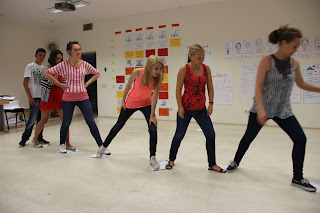
Coping skills freeze tag is great for people to identify coping skills that they can use and when they can use them. Peers listening to each other's coping skills can also help give new ideas.


How To Play:
Designate one player as 'it' with the other players scattered throughout the playing area. The person who is it tags the other players. When a player is tagged, (s)he freezes. To be unfrozen, the player has to name a coping skill and be unfrozen by getting a high-5 from another peer who is not frozen.
I like to make a rule that people cannot repeat coping skills so that they have to think of more.
With younger groups, you may need to talk about what coping skills are beforehand and have older kids give examples so everyone understands.

Discussion:
Coping Skills: ask each participant what their favorite coping skill is and when they can use it

Please Share Your Thoughts and Ideas:
What are things you would discuss with this game?
What are some other ways that you like to play tag?

Other Variations on Playing Tag:
Triangle Tag
Animal Tag
Freeze-Tag Toss
Spot Tag  

Image Credit: http://www.forthoodsentinel.com/images/photos/15751_tn.jpg

Tuesday, March 24, 2015

Group Juggling


Equipment: one ball for each person in the group


Objectives
First, ask your group who can demonstrate juggling (There is usually at least one person who can juggle). Ask, “Who can juggle the most balls?” Two or three balls are usually the limit.
Now have everyone (usually best with 8-12 people) stand in a circle about arm’s length apart.
Ask the participants to throw the ball to someone in the circle that is not standing next to them. each person catches the ball only once except it must start and end with the same person. tell them you are creating a pattern; they need to remember to whom they threw the ball and who threw it to them.
After the ball has made it around the group once, send in more balls until there are two less than the number of people in the group, or until they start dropping a lot. Try it two or three times. Ask them to be more efficient each time.

Discussion
How much more can a group accomplish than an individual?
What happens to the process when one person drops a ball? How does the group compensate?
Whose responsibility is it?
What does it take for a team to be successful?

Variations
Use stuffed animals instead of ball and use the story of Noah’s Arc and tell them water is coming in and we must juggle the animals to keep them from falling in the water.

 Image Credit:

Monday, March 2, 2015

Group Sit


Equipment: a rope tied in a circle

How to Play:
Put the rope on the ground. Have the participants grab the rope and pick it up to waist level. (You can have the rope tangled and tell them to untangle it at this point if you want to make it more challenging). Tell the participants to walk back until the rope is tight and to spread out evenly on the rope. Now, they are to sit down together as a team without ever moving their feet.

Discussion:
Discuss the importance of every member of the team
Teamwork
Communication
Feeling of Accomplishment
Enduring (not giving up even when it seems impossible)
Problem Solving
If someone stepped up to be a leader during the task, talk about leadership skills
If the group became frustrated, talk about healthy ways to deal with frustrations

Please Share:
What variations have you seen done with this activity?
How would you discuss this with your group?

Image Credit: http://hative.com/wp-content/uploads/2014/05/team-building/12-team-building.jpg

Tuesday, February 24, 2015

Spot Tag


Spot tag is a funny game for the participants to break the ice, laugh with each other, and work on important skills. They quickly realize how hard running is while trying to hold their leg, ankle, arm, head, etc.

How To Play:
Designate one player as 'it' with the other players scattered throughout the playing area. The person who is it has a ball (that is soft) that he throws to tag the other players. When a player is tagged by the ball, he has to cover the spot where he was tagged with one hand (but is still allowed to be chased) and continues running around. When tagged a second time, the player uses his other hand to cover the spot where he was tagged (but he is still allowed to be chased). When tagged a third time, he/she switches places with the person who is 'it'.

Once the ball hits the ground, it is considered "dead" so if it bounces and hits someone, that does not count. Also, only the person who is it can pick the ball up. No other player can pick it up.

Discussion:
Anger management: talk about how our anger can hinder us and how we can learn to control it
Depression: similar to anger, talk about how depression can hinder us and how we can improve our mood
Laughter: talk about the importance of laughter and enjoying ourselves
Exercise: talk about the importance of exercise and how it can improve our mood and is good for us

Please Share Your Thoughts and Ideas:
What are things you would discuss with this game?
What are some other ways that you like to play tag?

Other Variations on Playing Tag:
Triangle Tag
Animal Tag
Freeze-Tag Toss 
Coping Skills Freeze Tag 

Image Credit:
https://aames3.files.wordpress.com/2011/04/kids-running_300.jpg

Monday, February 16, 2015

Lava River


Objective: participants work together to move entire group across simulated “lava river”

Emphasis
·      Develop cohesion and teamwork
·      Enhance communication skills
·      Stimulate care and concern for others through individual and group responsibility
·      Identify or improve leadership potential
·      Establish support systems

Materials
·      A large open area, a hallway or gymnasium floor
·      One block, brick or rock for each participant (various sizes of cut 2”x4” work very well. Pick up scrap lumber, different shaped wood from a construction site or a piece of paper if you are really low on budget/time)

Instructions
·      Mark a start and finish line on the field
·      Give each participant one block. Explain the only place a team member can step is on the blocks
·      Team members lay down the blocks one at a time in a line toward the finish point, with team members standing on the blocks. It will be necessary to share blocks in order that an extra block is made available
·      Pass the extra block to the front team member who places it on the ground in front of him
·      Repeat this process until all have crossed the “lava river”

Variations
·      Have each member choose a block that represents them. then allow each member to share with the group the attributes that the block possesses that are similar to the individual. Do not give any instructions as to how to complete the task. Remind them the block represents themselves and others and they need to learn and practice using themselves and others as a support system
·      Teach social responsibility by establishing the rule that if one team member steps off the blocks or has some other miscue where the floor is touched, the entire team must return to the beginning to start the exercise again
·      Divide large groups into competing teams and challenge each other to the finish line, or race against set time
·      Give an extra block to the group, or take one block away
·      Blindfold a member of the group to increase care and responsibility for one another
·      Individuals must step on the blocks and not skate across the area on them
·      Do not give specific instructions, but tell group to figure out possibilities
The group must get everyone through an electric tunnel. No one can touch any of the interior or exterior sides of the tunnel or anything that is touching those sides. The group is provided with some “insulated blocks.” Location should be any open area where a tunnel can be improvised out of boxes, etc. or an area where a tunnel area

Image credit: https://blogger.googleusercontent.com/img/b/R29vZ2xl/AVvXsEi1O1D-3RK-FCODUOUGrWnSDhDGxzyAiY3WvVV8MLp8KthusIvKK93UaXPNmnHuMupkhxG43d4ucf6RkvPMKuLXzmCXsZd6I7MDH7f6Jid5TD3mEZVhiIY1PobBqmxLSFBn2AJCLnXE3yE/s1600/IMG_3220.JPG

Monday, October 6, 2014

Freeze-Tag Toss

Materials
  • Soft item/ball
How to Play
Have a team of taggers and a team of people to be frozen (about a 1:5 ratio). The team that can be frozen will have a soft item/ball. The taggers try to freeze everyone. The only way to be unfrozen is to receive a high-5 from someone who is holding the soft item/ball (cannot throw it at the frozen person). The team that can be frozen can pass the soft item/ball to people who are not frozen. If the person holding the soft ball/item is frozen, s/he must drop the soft item/ball, and another player will have to pick it up. The taggers can never touch or hold the soft item/ball. The round is complete when everyone is frozen except the taggers. Then select new taggers and start over until you run out of time!


Lessons Learned
Communication - How did you know who to pass the soft item/ball to?
Instant Gratification - Did you always get the soft item/ball when you wanted it?
Teamwork
Problem Solving - Did y'all have a strategy of who to throw the soft item/ball to? (ex. pass it to a person closest to a frozen player) Did your strategy always work out? How did you adapt it?
Sharing - Did anyone refuse to pass the item/ball?

How would you use this activity? Do you know other tag variations?

Other Variations on Playing Tag
Triangle Tag
Animal Tag
Spot Tag 
Coping Skills Freeze Tag

Photo Credit: http://www.google.com/url?sa=i&rct=j&q=&esrc=s&source=images&cd=&cad=rja&uact=8&docid=JrL-3-mT86rDVM&tbnid=sDAYSBxLeQrMOM:&ved=0CAcQjRw&url=http%3A%2F%2Fcommunity.annthegran.com%2Fpost%2F2008%2F04%2F24%2Fa-magic-bookshelf-game-what-are-tags-and-how-do-i-use-them&ei=OggyVMG8IcGnyATtz4DIBA&bvm=bv.76802529,d.aWw&psig=AFQjCNH1uYIbzguxRbn9d5ydLMCqpccTPQ&ust=1412651446497669

Saturday, September 27, 2014

Traffic Jam

Equipment
  • Something for each participant to stand on plus one extra - I've used foam squares, put X's on the floor with tape, etc.
    How To Play
     The participants stand in a semi-circle with one marker on the ground that each participant stands on. Put the extra marker in the middle (you do not need an equal number of participants). All participants should face in-wards toward the empty marker. The object of the game is to get the two sides to pass each other, ultimately switching sides by moving strategically from one marker to another.


    Rules
    • Only one person can be on a marker at a time
    • Participants can only move to an empty marker
    • Participants can only move forward - if the group gets struck, everyone has to start over
    • Participants can skip one person going the opposite direction, but s/he cannot skip someone going the same direction (to walk around the other person, the participant can step off the marker and walk around the person to step on the empty marker)
    Variations
    • When the group gets stuck and has to start over, have the participant at the front marker move to the last marker so there is a new person leading every time
    • Have the group do it without talking. Be strict about it, and when they start to get frustrated, allow them to talk. Process the differences after the activity
    • Once the group gets it the first time, have them do it while holding their breath. If someone breathes (exhales or inhales) in the middle, make them start over. This takes precise knowledge and planning. After, process the difference  between just doing what you are told and knowing your place/role.
    • Try the activity with two lines in a "plus sign" formation with one empty spot in the middle

    ·   
        Solution
    ·      This activity works even if you have odd numbers. First move a person forward into the empty space. Then the first person from team 2 goes around to the empty space, and the second person from team 2 steps forward. This pattern continues (team 1 moves one person, team 2 moves two people, team 1 moves three people, team 2 moves four people, etc.) until all people are moved. After all have moved, the pattern is reversed: five people move four, three, two, one.
    ·      Hint: There are three “unspoken rules” that if followed, will solve this puzzle. First, at every juncture, there are only two possible moves: one will get them stuck and the other will not. Second, participants from opposing team should always be alternating on the spaces. If one team has two in a row, they have created a traffic jam. Third, for the first half of the game, when they arrive at a juncture, always move the person that is positioned closer to the outward tails of the semi-circle, not the person closer to the center. After all participants have moved, the pattern is reversed.

    Lessons Learned
    Process with the group throughout - talk them thru their frustration, ask how their current solution is working, help them listen to each other if they are struggling to do so, etc.

    Problem Solving: At the beginning of the activity, participants often say this activity is impossible, but by the end, they feel great! When the group makes unanimous decisions, they usually make fewer mistakes. Some problems get solved much faster if you focus on the process or how you are interacting, rather than focusing on the problem.
    • How did it feel to accomplish an “impossible” task? 
    • Would you be given a task if there was not a way provided to accomplish it?
    • What steps were taken to get the activity done?
    ·      Communication:
    •       Whose ideas were important? (every suggestion)
    ·      Teamwork:
    •       How many people did it take to do this activity?
    •       How difficult would it be to accomplish this task if someone was not cooperating or doing their part?
    ·      Frustration

         Enduring
    •       What was more rewarding, the fact that everyone is standing in a different place or the process that brought you there? How does that relate to your life and other projects you are involved in?

    Picture Credit:
    First picture: http://www.playmeo.com/uploads/89ac3ca9270f995412eccd8c13c609bd.png
    Second picture: http://eaglepointresort.com.ph/wp-content/uploads/2014/08/team-building-project-adventure-w18368-traffic-jam-4.jpg

    Tuesday, September 23, 2014

    No-Outs Dodgeball

    The rules are the same as dodgeball, but there are no outs!


    Materials:
    • 10-15 dodgeballs
    • 5-8 cones
    Set Up: Split the court in half and spread the balls on the half-court line evenly. Use the cones to create a line on both halves of the playing field. When a player is hit, they have to stand behind the line of cones on their side of the court and cannot cross it. They can still throw balls to hit the other team to get them out. If a player who can still cross the cones catches a ball, a player who was stuck behind the cones can become unstuck. If any player (including those who are stuck behind the cones) catches a ball, the person who threw the ball is now stuck behind the cones. The team left with players able to cross the cones wins.

    Here is a drawing of how the court looks when set-up:
    The triangles represent the cones and the circles are the dodgeballs.


    Lessons Learned
    Teamwork
    Communication - did those who could cross the line give balls to those who could not?
    Keep trying - even if we get "hit with a dodgeball", we can still do our best and help others
    Work with our limitations

    Picture Credit: http://socalmusicservices.files.wordpress.com/2011/09/dodgeball.jpg

    Thursday, May 29, 2014

    Nitro Straws


    Tell this story (or a similar one): “You are scientists working in a laboratory with nitroglycerin in test tubes. Somebody was walking along with a tray full of tubes and tripped, making the tubes fly. You all rushed together and caught the tubes in your hands as you have them now. You had to catch them in this way because the sides are very fragile, and if you touched them they would likely break and cause a huge explosion. Such an extraordinary feat caught the attention of the press, and they would like a photo of you, but they need to see your faces. As a collective group you need to turn around so you end up facing outward. You need to do this without dropping the straws or touching the sides, otherwise everything blows up, and you must begin again.”
    Everyone stands in a circle facing inward. Each participant points both fingers (arms at their sides with elbows bent at a ninety degree angle). The right palm should be facing up, and the left palm should be facing down. Place a straw in between the boys’ fingers (one boy’s finger on top and another boy’s finger on bottom and so on around the circle). They must figure out how to turn around without touching the sides of the straws or dropping them. If they accidentally do, they must restart.  
    Variation:
    Blindfold a participant if they are getting it too quickly or one person is always the leader, and you want someone else to step up.


    Life Lessons:
    This game is very frustrating so talk about their frustration, what they did, what they could have done better, what worked, etc.

    Teamwork
    Communication
    Problem Solving

    Please Comment Below: Have you used this activity or one similar to it? What was your experience with it? I'd love to hear any ways that you have adapted it or processed it!

    Photo Credit: http://m7.i.pbase.com/u35/sleeper55/upload/23113917.Straws.jpg

    Thursday, May 22, 2014

    Pipeline


    Tell the participants the rules and have them figure out their order. Once they have that down, put the marble in the first pipe, and the participants will try to figure out how to continue moving it to the bowl. If the marble hits the floor, they must start over – give them a few moments to come up with a strategy. Ask what did and did not work to help them get going.

    Rules:

    ·       Alike pipes cannot touch

    ·       Cannot touch others’ pipes with your hands/feet/etc.

    ·       Cannot touch marble

    ·       Must stay in the same order throughout the whole activity

    ·       Marble must move through the pipe

    ·       Once the marble is in a pipe, that pipe cannot move towards the bowl

    Paradigm Shift


    Materials:

    ·       A PVC pipe for each participant (Half should be completely round and the other half should have the top cut off)

    ·       One marble

    ·       A bowl

     Life Lessons:
    Importance of working together-no one could have done this by themselves just as they cannot reach all of their goals by themselves
    Talk about how they approached this activity and how this compares to how they approach their treatment 
     Communication 
     Speed of the activity: was it easier when they went slow or fast? 
     Leadership


    Please Comment Below: Do you have any tips or words of advice for running this activity or one similar?


    Picture Credit: http://myparadigmshift.org/wp-content/uploads/2011/02/pipeline-pic1.jpg
     

    Monday, May 12, 2014

    Loose Caboose


    Split the students into group of 3-4 people. Have two people that are not in a group. One person will be the loose caboose, and the other will be the chaser. The loose caboose is trying to hook onto a train. When this happens, they make a train noise signaling for the front person (engine) to break off and become the loose caboose. All the while, the chaser is trying to tag the loose caboose before he grabs onto a train. When the chaser tags the loose caboose, they switch roles. If they get out of control, re-group, and slow down.
     

    Variation: Put all of the students in trains (groups of 3-4). Tell them the goal is to create the longest train, but when someone grabs onto your shoulders, you have to let go, becoming a new engine.
    Lessons: boundaries, personal space 

    Please Comment Below: How did this activity work for your group? Did you do it with a large or small group? What did you process?

    Picture Credit: http://www.pmap.co/c/522febd7/images/stories/birthday-party-activities/outdoor_party_games_dragon_tail_chase.jpg

    Friday, May 2, 2014

    Toe Fencing

    To play, face each other, holding hands. Then try to tap the tops of each other's toes with your toes. When one of the partners scores three hits, it is time to switch to a new partner. Players should be equally armed - barefoot vs. barefoot, shoe vs. shoe, etc. Remember the name of the game is toe fencing, not toe stomping.


    Life Lessons
    Have fun, importance of laughter, etc.
    Why somethings are okay in certain situations but not others, boundaries, etc.

    Please Comment Below: What group did you do this activity with? How did you adapt for the safety of your participants?

    Here are a few links to ideas on how to lead activities better:

    Credits: pictures from http://media-cache-ec0.pinimg.com/236x/01/18/22/0118221822e60667a0db4c65126bc54c.jpg

    Monday, April 28, 2014

    Group Juggling

    First ask your group who can demonstrate juggling (There is usually at least one person who knows how to juggle). Ask, "Who can juggle the most balls?" Two or three balls are usually the limit. Now have everyone (usually best with 8-12 people) stand in a circle about arms length apart. As the leader you say, "I am going to pass this ball around, and you remember the order" (who you got it from and passed it to). No one can have it twice, and you can not pass it to the person on either side of you. After the ball has made it around the group once, send in more balls until there are two less than the number of people in the group, or until they start dropping a lot. Try it two or three times. Ask them to be more efficient each time.
     

    Recommendations
    Ask them to challenge themselves on how many they can do or how quickly they can do it.

    Life Lessons
    Talk about how much one person can do alone (juggle 2 or 3 balls) and compare it to how many the group can juggle (6-8 balls and possible more). 
    If balls were dropped during the game, talk about how a group comes back when one person messes up. 
    You can talk about what it takes for a group to be successful. 
    You can have the students say something the ball represents for them. Then talk about the repercussions of dropping it and why they dropped it.

    Materials
    • 6-8 small balls (usually 2 less than the number of participants ex. 8 participants=6 balls)
    Please comment below on how you would use it with your population, thoughts on how it has worked for you, advice for others on how to implement it, what you would process and so on! We'd love to hear about it! 
      
    Here are a few links to ideas on how to lead activities better:

    Credits: picture from http://www.developing-potential.co.uk/wp-content/uploads/2012/08/Group-Juggle.jpg

    Monday, April 21, 2014

    Triangle Tag

    To start, make groups of 4 (you can do a group of 5 if necessary). Have three of the people in the group hold hands in a triangle facing each other. The other member of the group is outside of the triangle. One person in the triangle is 'it,' and the person outside the triangle is trying to tag the person who is 'it.' The other two members of the triangle are trying to keep the 'it' person from being tagged. If the game is too hard for the chaser, you can have the people in the triangle put their hands on each others' shoulders rather than holding hands.

    Life Lessons
    Talk about support systems
    Talk about the things that would bring us down such as habits, peers, etc.

    Other Variations of Tag
    Freeze Tag Toss 
    Animal Tag 
    Spot Tag   
    Coping Skills Freeze Tag 

    Please comment below on how you would use it with your population, thoughts on how it has worked for you, advice for others on how to implement it, what you would process and so on! We'd love to hear about it!

    Here are a few links to ideas on how to lead activities better:

    Credits: picture from http://www.siblingsupport.org/sibshops/triangle-tag.jpg/image_preview

    Wednesday, May 22, 2013

    Doctor and Goliath Dodgeball


    Dodgeball is a classic! I have always enjoyed playing. Recently, I found a new way to play the game. It keeps the integrity of dodgeball and makes it more fun. The game is called Doctor Dodgeball. I have also added a new twist on this game called Goliath Dodgeball. Together, they are definitely my favorite!

    My Experience
    I LOVE this game!!! I have run this game with children as young as 7 years old and adults as old as 24 years old. I have played with as few as 6 kids to 30 adults (thirty was a little crazy - I would recommend splitting it into two different games of dodgeball if you have this many people). It has become one of my favorites! The point is to keep everyone participating in the game rather than being on the sidelines. The way to best introduce this is to start off with the doctor and play a few rounds. Then add the goliath. This way they understand what is going on without too many changes at once.

    Doctor Dodgeball


    Divide the players into two equally numbered teams, and have each team stand on their half of the playing area. Give each team one minute to designate one player to be their 'doctor.' The teams do not disclose who their doctor is to the other team. The doctor is able to 'heal' any of the players that are hit and who already got out of the game (players can be healed as many times as they get out). The way I have done this is have the players who have been hit put their hand out for a high-five. The doctor 'heals' another player by giving him/her a high-five.

    The objective is to hit all the opposing players and/or the opponent's doctor (with the soft foam balls) to win the game. The game begins with a staff saying go, then the players run to the middle, and grab the balls to start throwing at each other. Once a player is hit, he must put his hand out for a high five from the doctor which lets him back in the game. No one can rescue the doctor if he gets hit with the ball. The game ends when one side is all out. Change doctors with each round of play.


    Goliath Dodgeball
    The more I have played this, I have realized that the doctor version can go on forever. To help speed the game up, you can add a "goliath" on each team. If "goliath" gets hit, then the whole team is out. Each team should keep their goliath a secret. This keeps the game moving a lot faster! Then more people have a chance to be a doctor and goliath. You could also just do Goliath dodgeball without the doctor.

    Recommendations
    For the half-court line, I use frisbees because the participants can clearly see the line and the frisbees hold the balls in place so they are not rolling around. 

    Life Lessons
    Doctor dodgeball can be used to teach the importance of second chances. You can talk about how they felt when they were unable to play (left out, sad,etc.) and then how they felt after they had been 'healed' (included, excited, etc.). You can teach them the importance of including others and making friends.
    Goliath dodgeball can be used to teach the importance of every person and working together as a team. We are only as strong as the weakest person. 

    This can be played inside on a basketball court or in a multipurpose room. Outside, it can be played on a nice grassy area or pavilion. If you play outside, you will be chasing the balls down. I would recommend playing in an area with walls on either side so the balls are easier to get.

    Materials


    • 10-20 balls
    • Frisbees or something else to create a halfway line


    Please comment below on how you would use these activities with your population, thoughts on how it has worked for you, advice for others on how to implement it, what you would process and so on! We'd love to hear about it! 

    Here are a few links to ideas on how to lead activities better:


    Credits:
    I first read about this game in the book, The Ultimate Playground and Recess Games on page 78. I took the game they outlined and put my own little spin on it.
    Image 1: http://weaselzippers.us/wp-content/uploads/32176_f5b5bf19a3aba022690e1fcf958060ad_0edfaefda77751a01d900f56da0f1780.jpg
    Image 2: http://images.collegemagazine.com/userFiles/gallery/articles/b0b36a9b4cce07b49c2df9009607b04a_b.jpg
    Image 3: http://www.bhf.org.uk/images/ud%20-%20teachers%20image_article.jpg